
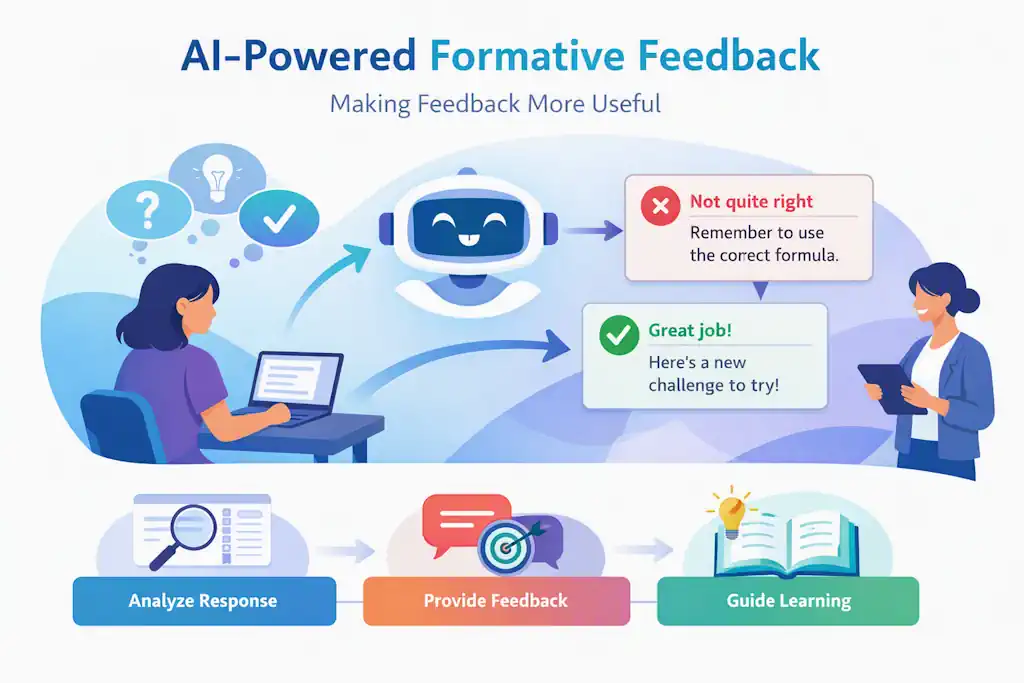
Feedback is one of the most important parts of learning. Students need to know not only whether an answer is correct, but also what they understand, what they missed, and what they should do next.
Traditional feedback, however, can be difficult to provide consistently. Teachers may have dozens of students and limited time to review every response in detail.
How AI can support formative feedback
AI-powered learning systems can analyze student responses and provide feedback during the learning process rather than waiting until the end of an assignment or test.
Depending on the system, AI can help identify patterns in student work, recognize common errors, explain concepts in different ways, and suggest additional practice.
The goal is not simply to tell students whether an answer is right or wrong. Effective feedback should help students understand why an answer needs improvement and what they can try next.
From correction to guidance
AI can make feedback more responsive by using information from the student's current interaction and, when supported by the system, their previous learning activity.
For example, instead of repeating the same explanation after an incorrect answer, an AI-supported system can provide a different explanation or direct the student toward prerequisite knowledge.
This can make feedback more closely connected to the student's immediate learning needs.
Why timing matters
Feedback is most useful when students can act on it.
Providing guidance while students are practicing allows them to correct misunderstandings before they become reinforced. AI can help make this type of support available more consistently, including when a teacher is working with other students.
Research on AI-assisted feedback has found promising effects across different educational settings, while also highlighting challenges such as inaccurate feedback and the need for appropriate oversight.
How UpUpEdu uses AI
UpUpEdu uses AI to analyze student responses, identify patterns of understanding, and dynamically adjust instructional support.
The platform provides guided practice, feedback, targeted lessons, and curriculum-aligned tutoring. When a student struggles, the system can provide focused instruction designed to reinforce prerequisite knowledge.
This approach allows AI to provide additional support while keeping learning connected to classroom instruction and curriculum goals.
AI feedback and the teacher
AI-generated feedback should complement, not replace, teacher expertise.
Teachers understand classroom context, student needs, motivation, and progress in ways that automated systems cannot fully capture. AI can help with the volume and speed of feedback, while teachers remain responsible for instructional decisions and professional judgment.
UNESCO similarly emphasizes a human-centered approach to AI in education, including appropriate safeguards, privacy, and meaningful human involvement.
The future of formative feedback
As AI systems become more capable, feedback can become more immediate, targeted, and responsive to individual learning needs.
The most useful role for AI is not simply producing more feedback. It is helping students receive useful guidance at the moment they need it, while giving teachers another tool to support learning.
Research references
Wang, et al. (2025). Unraveling the mechanisms and effectiveness of AI-assisted feedback in education: A systematic literature review.
Lee, S. S., & Moore, R. L. (2024). Harnessing Generative AI (GenAI) for Automated Feedback in Higher Education: A Systematic Review. Online Learning, 28(3), 82-106.
Miao, F., & Holmes, W. (2023). Guidance for Generative AI in Education and Research. UNESCO.