
For decades, classroom instruction has often been organized around a common curriculum and shared sequence of instruction. While teachers routinely differentiate instruction and provide additional support, delivering individualized learning at scale remains a challenge. Students can enter the same lesson with very different levels of prior knowledge: one student may need additional practice with a foundational concept, while another may already be ready for a more advanced challenge.
Intelligent educational technologies offer one way to address this challenge. By analyzing information generated during learning, adaptive systems can identify patterns in student performance and adjust instructional support to better match individual needs. The goal is not to replace teachers, but to make it easier for educators to provide the right kind of support to more students, more consistently.
What are intelligent algorithms in education?
In education, intelligent algorithms include both rule-based methods and AI or machine-learning models that use information about student interactions to support instructional decisions. Depending on the system, relevant signals may include:
- answers to questions;
- demonstrated mastery of particular skills;
- previous learning activities;
- patterns of errors;
- attempts and revisions;
- progress through instructional material;
- interactions with explanations or feedback.
The purpose of analyzing these signals is to build a more informative picture of a student's current understanding and use that information to provide appropriate instructional support. This does not mean that an algorithm “knows” exactly what a student understands. Rather, it uses available evidence to estimate a student's current level of understanding and determine what type of instructional support may be appropriate.
A large systematic review of artificial intelligence in education identified adaptive learning and personalized tutoring as one of the major areas of AIED research, analyzing 2,223 research publications and finding that adaptive learning and personalized tutoring were the most extensively studied category among the AI applications examined.
From fixed sequences to adaptive learning paths
Traditional instructional materials often present concepts in a predetermined order. Adaptive systems introduce more flexibility by responding to evidence of what a student understands. If a student demonstrates difficulty with a prerequisite skill, an adaptive system may provide additional explanation or practice before moving forward. If a student demonstrates sufficient understanding, the system can provide opportunities to continue to the next concept.
This distinction is important: educational AI should support instructional decisions rather than replace professional judgment. Algorithms can surface patterns and suggest next steps, but teachers bring knowledge of their students, classroom context, instructional goals, and social and emotional needs that an algorithm cannot fully capture.
Four ways intelligent algorithms can support learning
1. Personalized content recommendations
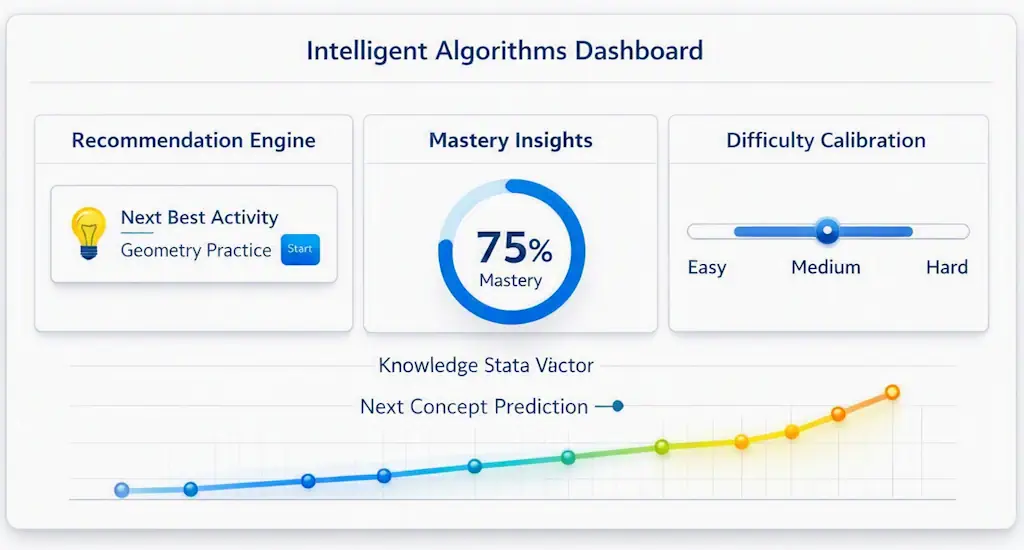
Recommendation algorithms can help determine which learning activity, explanation, example, or practice opportunity may be appropriate for a student based on previous performance. Instead of giving every learner exactly the same sequence, an adaptive system can provide additional support where evidence suggests it is needed and offer enrichment when a student is ready for more challenge.
Research on AI in education consistently identifies personalized tutoring and adaptive learning as important applications of educational AI, but also emphasizes that the impact depends on how these systems are integrated into instruction and how teachers and students use them.
2. Mastery-based progression
Mastery-based systems use student performance to estimate whether a learner has demonstrated sufficient understanding of a particular skill or concept. When evidence of mastery is insufficient, the system can provide additional practice or revisit prerequisite knowledge. When the student demonstrates stronger understanding, the system can continue to the next learning objective.
This approach can help reduce the risk of moving through a curriculum while important foundational concepts remain unresolved. It also makes it easier for teachers to see which students may need targeted support and which students are ready to move ahead.
3. Adaptive difficulty and feedback
Students can become frustrated when work is consistently far beyond their current level, and they can receive too little challenge when material is consistently below their level. Adaptive systems can use performance information to adjust the type or difficulty of practice and the level of instructional support provided.
Recent research supports the potential of AI-enabled adaptive learning systems, although the size and consistency of learning effects vary across studies and educational contexts. A 2024 meta-analysis examining AI-enabled adaptive learning systems from 2010-2022 found measurable effects across learner outcomes while also identifying variation associated with characteristics of the interventions and learners.
4. Identifying potential learning gaps
Patterns in student responses can provide useful signals about concepts that may require additional attention. For example, repeated errors on related questions may indicate that a student needs additional practice with a prerequisite concept. Similarly, performance patterns across several activities can help educators identify areas where a group of students may need additional instruction.
These signals should be treated as evidence to support instructional decisions—not as definitive judgments about a student's ability. When used thoughtfully, they can help teachers focus limited instructional time where it is likely to have the greatest impact.
How UpUpEdu applies AI to support students
UpUpEdu provides an AI-powered tutoring platform designed specifically for K-12 schools and districts. The platform is designed to support instruction rather than replace teachers. Its public product description states that the system analyzes student responses to identify patterns of understanding and dynamically adjusts instruction.
Personalized instruction
UpUpEdu uses student learning information to provide individualized instructional support. The platform can adapt instruction based on patterns in student responses and demonstrated understanding, offering additional scaffolding when students struggle and more challenging tasks when they are ready to advance.
Targeted support for learning gaps
When students struggle with a concept, UpUpEdu can generate focused lessons designed to reinforce prerequisite knowledge. This allows students to receive additional instruction without requiring every student in the class to repeat the same material. In this way, AI-powered tutoring helps make differentiated instruction more scalable.
Guided practice and feedback
The platform provides guided practice and feedback while maintaining alignment with classroom instruction and curriculum objectives. Rather than positioning AI as a replacement for educators, UpUpEdu describes its system as an instructional partner that complements teacher-led instruction.
Curriculum-aligned AI support
UpUpEdu is designed around curriculum-aligned instruction. Its platform is intended to provide tutoring and learning support connected to instructional standards and lesson objectives rather than functioning as a completely open-ended AI system. This alignment helps ensure that AI-powered practice reinforces what students are learning in class.
Scalable personalization
One of the challenges facing schools is providing individualized support to large numbers of students. AI-powered tutoring can provide students with access to guided practice and feedback without requiring a teacher to provide every interaction individually. This creates an opportunity to extend personalized support while allowing teachers to remain responsible for instructional decisions.
What does research say about intelligent tutoring?
Research into intelligent tutoring systems has been developing for decades, and the evidence is increasingly broad. A well-known meta-analysis by Kulik and Fletcher examined 50 controlled evaluations of intelligent tutoring systems and reported positive effects on test performance compared with conventional instruction, while also noting that results varied depending on how outcomes were measured and how the tutoring system was implemented.
More recent research provides a more nuanced picture. A 2024 meta-analysis examined AI-enabled adaptive learning systems used between 2010 and 2022 and found evidence of effects on learner outcomes while emphasizing that results vary across contexts and intervention characteristics.
Research focused specifically on K-12 is particularly relevant to schools. A 2025 systematic review examined 28 studies involving 4,597 K-12 students and found that intelligent tutoring systems generally showed positive effects on learning and performance, but those effects were reduced when compared with non-intelligent tutoring systems. The authors emphasized the need for longer interventions, larger and more diverse samples, and further investigation of ethical considerations.
A global meta-analysis of personalized and adaptive learning technologies in reading literacy similarly reported positive average effects, while highlighting substantial variation across implementations and contexts and underscoring the importance of thoughtful design and integration into instruction.
Taken together, these findings suggest an important conclusion: educational AI is promising, but technology alone does not guarantee better learning. Outcomes depend on how the system is designed, how it is integrated into instruction, and how educators and students use it.
AI should support teachers, not replace them
Effective educational technology should strengthen the relationship between students and educators. AI can help identify patterns, provide additional practice, generate explanations, and make individualized support more scalable. Teachers, however, bring knowledge of their students, classroom context, instructional goals, and social and emotional needs that an algorithm cannot fully capture.
For this reason, UpUpEdu is designed to complement teacher-led instruction rather than replace teacher judgment. The most useful role for intelligent educational technology is therefore not to make decisions instead of educators, but to provide educators and students with additional information and instructional support.
Responsible use of learning data
Personalized learning depends on information about student learning. That makes responsible data practices an essential part of educational AI. Research on AI-enabled personalized learning identifies data privacy, ethical considerations, educator readiness, infrastructure, and equity as continuing challenges.
Educational AI systems should therefore be designed with appropriate safeguards, transparency, security, and human oversight. The objective is not simply to collect more student data. The objective is to use relevant learning information responsibly to provide more useful instructional support, while protecting students' privacy and ensuring that data use aligns with district policies and community expectations.
The future of personalized learning
AI in education is moving toward systems that can respond more dynamically to individual learners. Future educational platforms are likely to combine several capabilities:
- adaptive learning pathways;
- intelligent tutoring;
- personalized explanations;
- automated feedback;
- learning analytics;
- curriculum-aligned content;
- teacher-facing insights;
- and increasingly sophisticated AI models.
At the same time, research continues to emphasize the importance of evaluating these technologies carefully rather than assuming that personalization automatically produces better outcomes. The opportunity is not to create a classroom without teachers. It is to make individualized support more accessible within the classroom and to give educators better tools for understanding and responding to student learning.
References
- Wang, S., Wang, F., Zhu, Z., Wang, J., Tran, T., & Du, Z. (2024). Artificial intelligence in education: A systematic literature review. Expert Systems with Applications, 252, 124167. DOI: 10.1016/j.eswa.2024.124167.
- Wang, X., Huang, R. T., Sommer, M., Pei, B., Shidfar, P., Rehman, M. S., Ritzhaupt, A. D., & Martin, F. (2024). The Efficacy of Artificial Intelligence-Enabled Adaptive Learning Systems From 2010 to 2022 on Learner Outcomes: A Meta-Analysis. Journal of Educational Computing Research, 62(6), 1348-1383. DOI: 10.1177/07356331241240459.
- Létourneau, A., Deslandes Martineau, M., Charland, P., Karran, J. A., Boasen, J., et al. (2025). A systematic review of AI-driven intelligent tutoring systems (ITS) in K-12 education. npj Science of Learning, 10, 29. DOI: 10.1038/s41539-025-00320-7.
- Kulik, J. A., & Fletcher, J. D. (2016). Effectiveness of Intelligent Tutoring Systems: A Meta-Analytic Review. Review of Educational Research, 86(1), 42-78. DOI: 10.3102/0034654315581420.
- Alrawashdeh, G. S., Fyffe, S., Azevedo, R. F. L., & Castillo, N. M. (2023). Exploring the impact of personalized and adaptive learning technologies on reading literacy: A global meta-analysis. Educational Research Review. DOI: 10.1016/j.edurev.2023.100587.
- Additional discussion of AI techniques for adaptive and personalized learning can be found in: Artificial intelligence in adaptive education: a systematic review of techniques for personalized learning. Discover Education, Springer Nature.