
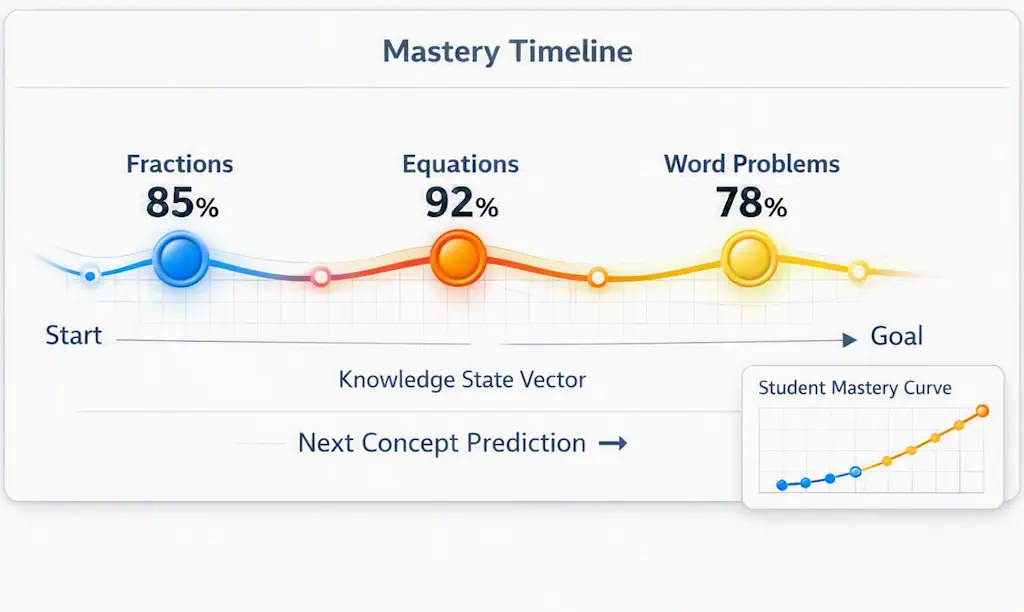
From isolated answers to learning over time
A student may answer one question correctly, struggle with the next, improve after receiving an explanation, and then demonstrate stronger understanding later. Looking at a single assessment captures only one point in that process, not the trajectory of learning itself.
Knowledge tracing takes a different approach. It uses a student's history of learning interactions to estimate how their knowledge state changes over time. Instead of treating every answer as an independent event, it considers the sequence of previous interactions as evidence about learning.
What is Deep Knowledge Tracing?
Knowledge tracing is the task of modeling a student's evolving knowledge based on their previous interactions with educational activities. Deep Knowledge Tracing (DKT) applies deep neural networks to this sequential problem.
A typical DKT system may process information such as:
- questions a student has attempted;
- whether responses were correct or incorrect;
- the sequence of those interactions;
- skills or concepts associated with activities;
- patterns of performance across multiple activities.
Using this information, the model can estimate a student's evolving knowledge state and predict how they may perform on future interactions. DKT does not directly observe what a student knows; it produces a model-based estimate from available learning data. A student's answer to a question is evidence about their learning, but it is not a perfect measurement of understanding.
This distinction is important when using knowledge-tracing models in real educational environments.
Why knowledge tracing matters
The main value of knowledge tracing is that it adds a time dimension to learning data. Instead of asking only, "Did the student answer this question correctly?", a knowledge-tracing system can also consider, "How has this student's performance changed across previous interactions?"
This can provide additional information for adaptive learning systems and help identify potential learning gaps earlier than formal assessments alone.
Identifying potential learning gaps
Knowledge-tracing models can use historical interaction patterns to predict performance on future activities. If a student's learning history suggests difficulty with a particular area, that information can be used as one signal when deciding whether additional practice or instruction may be appropriate.
For example, repeated difficulty with a prerequisite skill may suggest that the student could benefit from reviewing that concept before attempting more advanced material. However, predictions should be treated as signals rather than definitive judgments about a student's ability.
Informing the next learning activity
One of the potential applications of knowledge tracing is helping an adaptive learning system determine what a student may benefit from doing next. Suppose a student is beginning a more advanced mathematics topic, and their previous learning history indicates that they have not yet demonstrated consistent performance with a prerequisite skill.
An adaptive system could use this information, together with curriculum requirements and other assessment evidence, to provide additional practice or explanation before continuing. The important distinction is that DKT itself does not necessarily choose the next lesson.
Instead, its predictions can serve as one component of a larger adaptive learning architecture:
Student interactions → Knowledge model → Prediction → Instructional decision → Next activity
This separation helps clarify the role of a knowledge-tracing model within a broader personalized learning platform.
Supporting mastery-oriented learning
Knowledge tracing can also contribute to learning environments that provide students with additional opportunities to practice before progressing. An adaptive system can combine knowledge-tracing estimates with curriculum objectives, assessment results, mastery criteria, instructional rules, and recent student performance.
Together, these signals can help determine whether additional practice or instruction may be useful. The result can be a more flexible learning experience in which students do not necessarily need to spend the same amount of time on every concept.
DKT is not a complete personalized learning system
Deep Knowledge Tracing is a modeling technique, not an entire adaptive learning platform. A complete personalized learning system may contain multiple components, including:
- student data collection;
- knowledge modeling;
- prediction;
- recommendation or instructional decision-making;
- content selection;
- feedback and tutoring;
- teacher-facing information.
DKT can contribute to the knowledge-modeling and prediction stages. Other algorithms, instructional rules, and educational design decisions are needed to turn those predictions into actual learning experiences.
This means that DKT should not be described as a technology that automatically knows what a student should learn next. Its value comes from providing information that can be incorporated into a larger instructional system.
What does research say about DKT?
Deep Knowledge Tracing was introduced by Chris Piech and colleagues in 2015, demonstrating how recurrent neural networks could be used to model sequences of student interactions and predict future performance. Their work established DKT as an important direction in knowledge-tracing research.
Since then, the field has expanded significantly. Surveys and reviews published in 2022, 2025, and 2026 have examined deep-learning-based knowledge tracing, highlighting strengths, limitations, interpretability challenges, and the difficulty of translating model representations into meaningful educational knowledge states.
Recent work has also explored Transformer-based knowledge-tracing models and reported improvements in predictive metrics compared with selected recurrent neural-network baselines on benchmark datasets. These developments demonstrate that knowledge tracing remains an active research field.
At the same time, an important distinction must be maintained: improving a model's ability to predict student responses is not the same as proving that the model improves student learning outcomes. A model may achieve better prediction accuracy without automatically producing higher grades, stronger retention, or better academic performance.
The educational impact depends on how predictions are interpreted and how they are incorporated into instruction.
From prediction to personalization
The potential value of knowledge tracing comes from connecting predictions to meaningful instructional decisions. A simplified process might look like this:
- Observe: The system records relevant learning interactions, such as student responses and activity history.
- Model: A knowledge-tracing model analyzes the sequence of interactions and estimates the student's evolving knowledge state.
- Predict: The model estimates the likelihood of different outcomes on future activities.
- Interpret: The broader educational system considers those predictions alongside curriculum requirements, assessment results, and other relevant information.
- Support: The system provides additional practice, explanation, feedback, or another appropriate learning activity.
This final step is where knowledge tracing becomes part of personalized learning rather than remaining simply a prediction model.
How UpUpEdu uses AI to support personalized learning
UpUpEdu provides an AI-powered tutoring platform designed for K-12 schools and districts. According to the company's current product description, the platform analyzes student responses to identify patterns of understanding and dynamically adjusts instructional support.
It can provide targeted lessons to address learning gaps, guided practice, feedback, and curriculum-aligned support. These capabilities fit within the broader direction of intelligent educational systems: using information generated during learning to provide more targeted instructional support.
Knowledge tracing is best understood as one possible component within this broader ecosystem of AI-powered personalization, rather than as a complete description of everything an educational platform does. For students, the goal is to provide additional support when it is useful. For educators, the goal is to make individualized instructional support more scalable while preserving the teacher's role in understanding students and making instructional decisions.
AI and the teacher: complementary roles
Personalized learning does not mean removing teachers from the learning process. Teachers understand factors that are difficult for an algorithm to capture fully, including classroom context, individual student circumstances, instructional goals, communication and relationships, motivation, social and emotional factors, and observations from day-to-day classroom interaction.
AI systems can process patterns in learning data at a scale that would be difficult to analyze manually. These capabilities can complement teacher expertise. AI can help identify patterns and provide additional instructional support, while teachers interpret those signals, consider the broader context, and decide how best to respond.
The most useful role for educational AI is therefore not to replace teacher judgment, but to help make individualized support more accessible.
Important limitations of knowledge tracing
Knowledge tracing is powerful, but it is not perfect. Model predictions are estimates: a model does not directly observe a student's understanding, and its predictions depend on the quality and quantity of available data.
Student behavior can have multiple explanations. An incorrect answer may reflect a conceptual misunderstanding, a careless mistake, unfamiliar wording, or another factor. Likewise, a correct answer does not always mean that a student has fully mastered a concept.
Interpretability remains important. Deep-learning models can capture complex patterns, but those patterns are not always easy for educators to interpret. For educational applications, predictive performance should therefore be considered alongside transparency and meaningful instructional interpretation.
Better prediction does not automatically mean better learning. A model that predicts student responses more accurately is not necessarily a model that produces better educational outcomes. The ultimate value of knowledge tracing depends on what happens after the prediction is made.
The future of knowledge tracing
Knowledge tracing continues to evolve from early recurrent neural-network approaches toward models that incorporate attention mechanisms, Transformer architectures, richer student information, and more sophisticated representations of learning. At the same time, researchers are paying increasing attention to interpretability and to the relationship between predictive accuracy and actual educational value.
The next generation of personalized learning systems will need to do more than predict a student's next answer. They will need to connect those predictions to meaningful instructional actions, provide useful information to educators, and operate within responsible approaches to student data.
Deep Knowledge Tracing represents an important foundation for this direction. By analyzing the sequence of a student's learning interactions, knowledge-tracing models can provide a more dynamic picture of learning than isolated assessment results alone.
When combined with appropriate instructional logic, curriculum alignment, feedback, and teacher expertise, these models can become one component of a broader approach to personalized learning.
Research references
- Piech, C., Bassen, J., Huang, J., Ganguli, S., Sahami, M., Guibas, L. J., & Sohl-Dickstein, J. (2015). Deep Knowledge Tracing. Advances in Neural Information Processing Systems, 28. Official NeurIPS and arXiv records should be used; the paper does not have a DOI.
- Song, X., Li, J., Cai, T., Yang, S., Yang, T., & Liu, C. (2022). A survey on deep learning based knowledge tracing. Knowledge-Based Systems, 259, 110036. DOI: 10.1016/j.knosys.2022.110036.
- Liu, Z., Guo, T., Liang, Q., Hou, M., Zhan, B., Tang, J., Luo, W., & Weng, J. (2025). Deep Learning Based Knowledge Tracing: A Review, a Tool and Empirical Studies. IEEE Transactions on Knowledge and Data Engineering, 37(8), 4512-4536. DOI: 10.1109/TKDE.2025.3552759.
- Yang, H., Hu, J., Hu, S., Xu, Z., et al. (2026). A Survey of Deep Learning-Based Knowledge Tracing from Cognitive Processing Perspective. Neurocomputing, 660, 131879. DOI: 10.1016/j.neucom.2025.131879.
- Khosla, A., Singh, H., Aggarwal, A., & Bedi, J. (2026). A Knowledge Tracing Based Intelligent Framework for Formative Assessment of Students Skills. Complex & Intelligent Systems, 12, 22. DOI: 10.1007/s40747-025-02149-4.